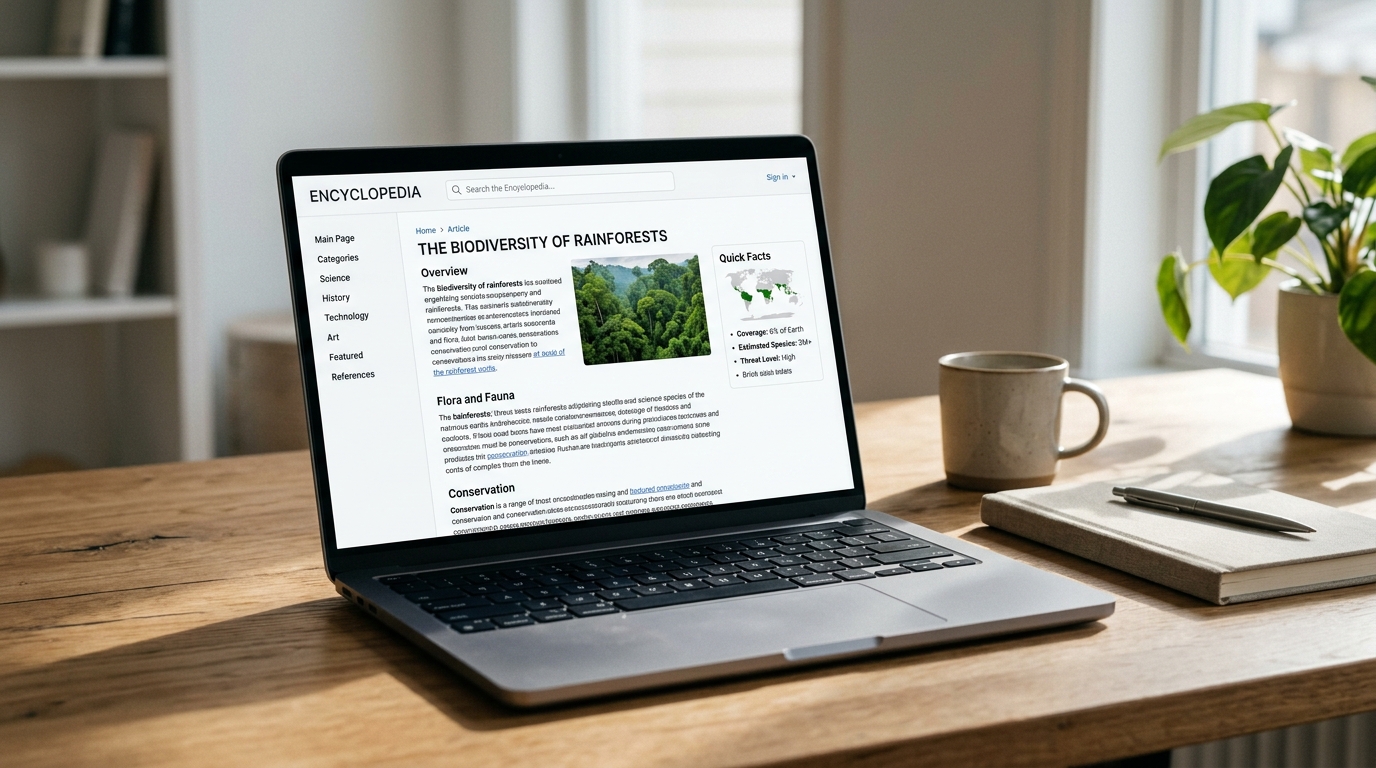
The internet contains more information than any library in history, yet access to useful knowledge is still uneven.
Some information sits behind paywalls.
Some is difficult to discover.
Some is scattered across thousands of unrelated pages.
Some subjects have extensive documentation, while others have surprisingly little organized information.
Open knowledge platforms can help address this problem by making useful factual information easier to discover and explore.
Information Is Not the Same as Knowledge
The internet has an enormous amount of content.
That does not mean it is organized.
Imagine researching an unfamiliar organization.
A search may return social media profiles, advertisements, press releases, directory listings, videos, news stories, and old webpages.
Each page provides one piece of the picture.
A knowledge platform attempts to organize the important information into a coherent subject.
This distinction is important.
Information becomes more useful when readers can understand how facts connect.
Open Access Lowers Barriers
Traditional reference resources could be expensive.
Academic databases often require subscriptions.
Specialist books may only be available through libraries.
Open online knowledge resources lower some of these barriers.
A student can begin researching without purchasing a large reference collection.
A business owner can investigate an unfamiliar industry.
A writer can learn basic background about a person or place.
A curious reader can explore subjects simply because they want to learn.
An open knowledge platform can therefore contribute to broader information access.
Knowledge Should Be Discoverable
Useful information has limited value if nobody can find it.
Searchable digital reference platforms help solve this problem.
Instead of requiring users to know exactly which document contains a fact, encyclopedia-style systems organize information around subjects.
People.
Companies.
Organizations.
Places.
Technologies.
Industries.
Cultural topics.
Educational institutions.
These categories mirror many of the things people naturally search for.
Open Does Not Mean Unverified
Open knowledge should still be responsible knowledge.
Information should be sourced appropriately.
Claims should be written carefully.
Promotional language should be controlled.
Corrections should be possible.
Readers should be able to distinguish evidence from opinion.
The strongest open knowledge platforms combine accessibility with editorial responsibility.
Without quality controls, more information can simply create more confusion.
Independent Knowledge Projects Increase Choice
A healthy information ecosystem should contain more than one source.
Different projects can document different subjects.
They can experiment with different editorial models.
They may focus on different communities, regions, languages, industries, or types of knowledge.
Readers benefit because they have more places to compare information.
Choice encourages better research habits.
Instead of asking, “What does one website say?” researchers can ask, “What do several credible sources show?”
Open Knowledge Helps Education
Reference information is especially useful at the beginning of learning.
A student may know almost nothing about a subject.
An encyclopedia-style article can introduce the main concepts and vocabulary.
Once those basics are understood, the student can move into textbooks, research papers, primary documents, lectures, and specialist sources.
Open reference resources make this first stage of learning easier to access.
Digital Knowledge Can Connect Subjects
One of the biggest advantages of online knowledge systems is linking.
A printed encyclopedia required readers to move between separate volumes.
Digital platforms can connect related topics immediately.
An article about a scientist can link to their university.
The university can connect to a city.
The city can connect to a country.
The scientist’s work can lead to a technology.
The technology can connect to companies and industries.
This network encourages discovery.
Global Knowledge Requires Broader Thinking
The internet reaches readers worldwide.
Knowledge platforms therefore have an opportunity to document more than subjects famous in one country.
Businesses, institutions, researchers, cultural figures, technologies, landmarks, and organizations exist in every region.
A global approach to reference information can help bring lesser-known but well-documented subjects into wider view.
Language access is another important part of this long-term challenge.
WikiPartner and Open Knowledge
WikiPartner positions itself around open encyclopedia-style knowledge, reliable sourcing, and editorial review, with an English edition currently available and additional language editions planned.
That broader model reflects an important direction for digital reference publishing: making useful knowledge easier to discover while maintaining processes around sourcing and review.
A Better Information Ecosystem
Open knowledge platforms should not try to replace every book, archive, search engine, database, or news organization.
Their role is different.
They can help organize the web’s information into understandable subjects.
They can introduce readers to unfamiliar topics.
They can direct people toward deeper sources.
They can connect related knowledge.
They can make information more accessible.
The future of knowledge online will likely involve many different systems working together.
Search engines will find information.
AI tools will summarize it.
Archives will preserve original materials.
Journalists will document events.
Researchers will create new knowledge.
Open encyclopedias can help organize that information for everyday readers.
A more useful internet is not simply one with more content.
It is one where reliable knowledge is easier to find, understand, verify, and explore.