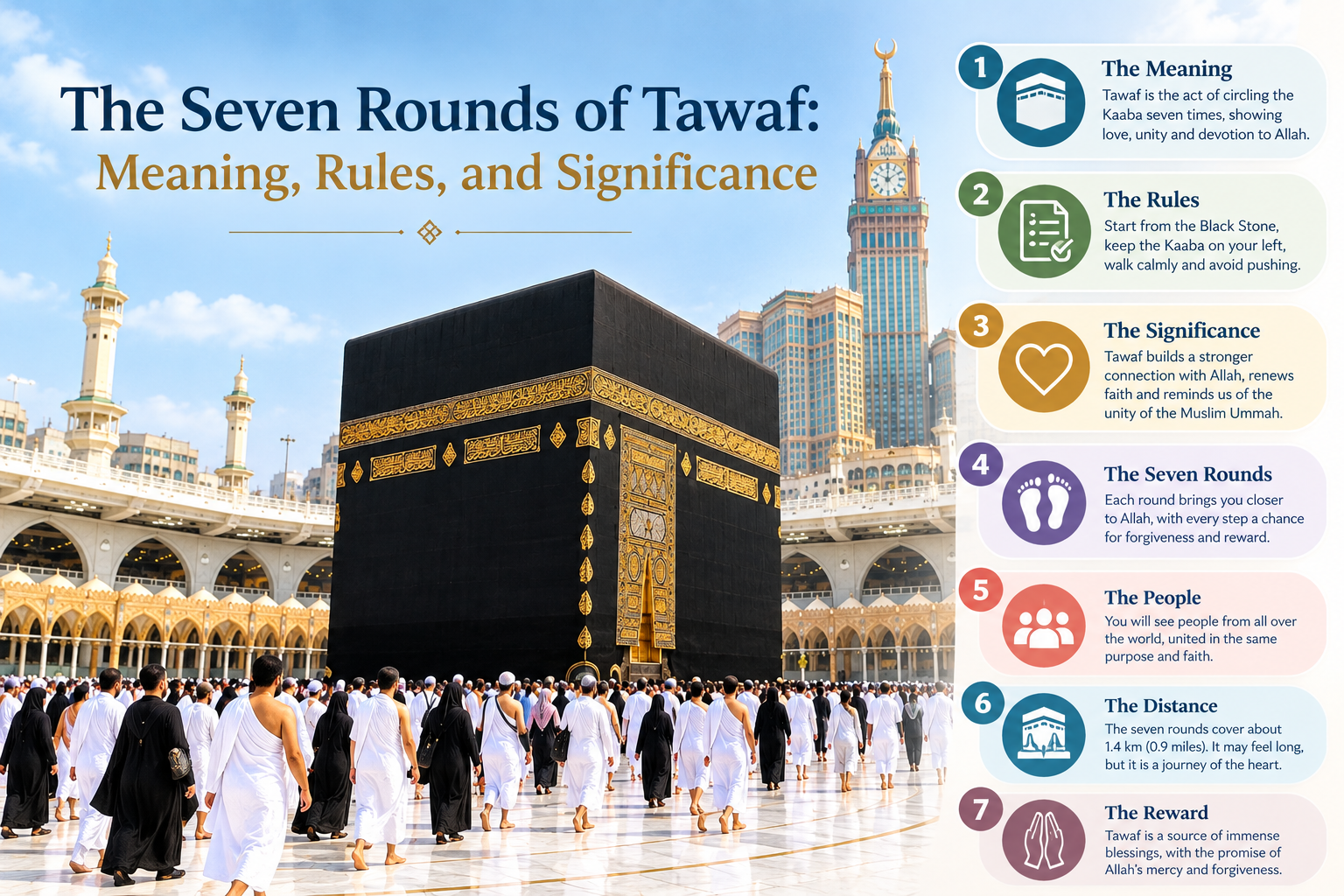
Few sights are as moving as the Kaaba surrounded by worshippers, all moving together in the same direction. This act is called Tawaf, and it is one of the central rites of both Umrah and Hajj. Whether you are preparing for your first journey or refreshing your knowledge, understanding the seven rounds will help you perform them with confidence, humility and sincerity. This guide explains the meaning, the rules, and the deeper significance of Tawaf in clear, simple language.
What Is Tawaf?
Tawaf means to circle or walk around something. In Islam, it refers to walking seven times around the Kaaba in the Masjid al-Haram in Makkah, keeping the Kaaba on your left. Many British pilgrims prepare for the journey with the support of a trusted provider such as Islamic Travel UK, but it is still important to understand the rite yourself so that you can focus fully on worship when you arrive.
There are different kinds of Tawaf, including Tawaf al-Qudum (arrival), Tawaf al-Ifadah (a pillar of Hajj), and Tawaf al-Wada (farewell). For Umrah, the Tawaf performed after entering ihram is an essential pillar of the rites.
The Meaning Behind the Seven Rounds
Why Seven?
The number seven appears often in Islamic practice, from the seven heavens to the seven laps of sa’i between Safa and Marwa. Scholars explain that Tawaf follows the example of the Prophet Muhammad (peace be upon him), and the number is a matter of devotion and obedience rather than something we need to question. Each round is a fresh act of worship, a chance to remember Allah and to ask for forgiveness.
Circling the Kaaba
The Kaaba is the direction that Muslims face in prayer every day. Walking around it brings that daily orientation to life. Pilgrims place Allah at the centre of their lives, and they move around that centre together as one community. Rich and poor, young and old, from every country, all follow the same path, which is a powerful reminder of equality and unity before Allah.
Rules and Preparation for Tawaf
Conditions Before You Begin
Most scholars say you should be in a state of ritual purity, meaning you have performed wudu, before starting Tawaf. Your clothing and body should be clean, and men should wear ihram with the right shoulder uncovered during Tawaf al-Qudum, known as idtiba. You should also cover the required parts of the body and make your intention sincerely for Allah alone. If your wudu breaks, step out of the crowd, renew it, and continue according to the guidance of your scholar.
Choosing the Right Journey
Good planning makes Tawaf easier, especially in busy seasons. Many travellers compare the best Umrah packages to find one that offers a hotel close to the Haram, sensible flight times, and clear transfer arrangements. Staying near the mosque saves energy, allows you to rest between rites, and makes it easier to find quieter moments for Tawaf. Always read what is included before you pay, so there are no surprises.
How to Perform Tawaf Step by Step
Begin at the line aligned with the Black Stone, facing it and making your intention. Say “Bismillah, Allahu Akbar” and, if you can do so safely, touch or kiss the stone. If not, point to it from a distance. Keep the Kaaba on your left and walk anticlockwise. Men should walk briskly in the first three rounds, known as raml, if they are able. Between the Yemeni Corner and the Black Stone, you can recite the dua, “Rabbana atina fid-dunya hasanah…”. Use any prayers you know in your own language throughout the rounds. After the seventh round, pray two rak’ahs behind the Maqam Ibrahim if space allows, or anywhere in the mosque, and drink Zamzam water.
Common Mistakes to Avoid
Some pilgrims push forward to reach the Black Stone, lose count of the rounds, or walk inside the Hijr Ismail, which is part of the Kaaba and must remain outside your path. Others get distracted by photographs. Staying focused, polite and aware of your surroundings will protect both your Tawaf and the people around you.
Planning Your Journey and Documents
Visa and Paperwork
Before you can perform Tawaf, you must be able to enter Saudi Arabia, which begins with having the correct documents. Many British travellers now apply for an Umrah visa online, either through an authorised provider or official Saudi channels. Check that your passport has enough validity, keep digital and paper copies of your documents, and confirm the latest requirements before you travel, as rules can change.
Tawaf for the Elderly and Unwell
Islam is a religion of ease. Those who cannot walk long distances may use a wheelchair or be carried, and many mosques offer designated areas and services. Do not feel any shame in seeking help. If you have a health condition, speak to your GP before travelling and rest as needed between rites. Allah knows your intention and your effort.
The Spiritual Significance of Tawaf
Tawaf is far more than a physical act. It is a living reminder that life should revolve around the worship of Allah. Each round invites you to reflect on your actions, to repent and to renew your hope in His mercy. Praying and making dua at the Multazam, the area between the Black Stone and the door of the Kaaba, adds to the beauty of the experience. Many pilgrims return home saying that the memory of Tawaf stays with them for life.
Final Thoughts
The seven rounds of Tawaf combine simple rules with deep meaning. By learning the conditions, following the Sunnah and approaching each step with sincerity, you can turn a busy rite into a moment of real closeness to Allah. Reviewing the common mistakes to avoid during Umrah can help you prepare well, stay patient with others, and let every round bring you nearer to your Lord.
Contact Islamic Travel UK
Address: Suite No.5, The Old Dispensary, 30 Romford Road, Stratford, London, England, E15 4BZ
Phone: 0203-970-4500
Email: info@islamictravel.co.uk
Frequently Asked Questions (FAQs)
What does Tawaf mean in Islam?
Tawaf means walking seven times around the Kaaba as an act of worship, beginning and ending at the Black Stone.
Why are there seven rounds in Tawaf?
The number seven follows the practice of the Prophet Muhammad (peace be upon him). It is performed out of obedience and devotion.
Do I need wudu for Tawaf?
Most scholars say wudu is required for Tawaf. If it breaks, renew it and continue, and ask a qualified scholar for guidance on your situation.
Which direction do you walk in Tawaf?
You walk anticlockwise, keeping the Kaaba on your left, starting from the Black Stone line.
Can I perform Tawaf if I am unable to walk?
Yes. Wheelchairs and assistance are permitted, and Islam allows ease for those with genuine difficulty.
What if I lose count of my rounds?
Many scholars advise acting on what you are most certain of, usually the lower number. For a personal ruling, speak to a qualified scholar.
Do I need a visa to perform Tawaf from the UK?
Yes, British travellers generally need a valid Umrah visa. Confirm the current rules with your travel provider or official sources before booking.