Introduction
If your cycle seems to have a personality of its own, you’re not imagining it. Hormones rise and fall week by week, and energy, sleep and mood tend to follow. That’s the gap IVY Cyclical Tincture is meant to fill.
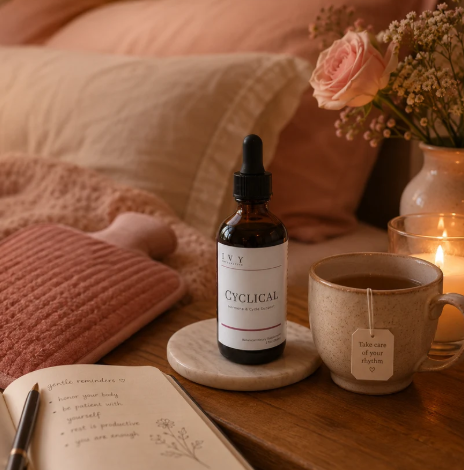
Made by IVY Apothecary, it’s a clinically informed botanical blend created to support hormone rhythm, vitality and ease across every phase of the menstrual cycle. It brings together four traditional herbs, Vitex, Dong Quai, Schisandra and Rose, in a liquid you take each morning. So what’s actually in that little brown bottle, and who should be careful with it?
Why Every Phase of Your Cycle Asks for Something Different
Most people think of the cycle as just the period, but it’s really a slow relay between hormones. The follicular phase starts on day one of bleeding and runs until ovulation, when an egg is released. After that, the luteal phase begins, with progesterone taking the lead until the next period arrives.
Each stretch can feel different. You might have plenty of drive one week and want a blanket and silence the next. That’s normal. A formula that claims to support the whole cycle, rather than one symptom, has to respect that ebb and flow. That’s the philosophy behind this tincture.
Its makers describe it as designed to honor the body’s natural rhythms through every season of womanhood, and the herbs they chose reflect that. Each one has a long history in traditional practice tied to cyclical balance, nourishment or emotional steadiness. Nobody’s promising a magic switch. It’s more like steady, daily support for a system that’s already working hard.
The Four Herbs Doing the Work
The formula is built around Vitex, Dong Quai, Schisandra and Rose. It’s a short ingredient list, which honestly I like, because you can actually learn what each plant is known for. One thing to flag: the product page doesn’t publish the amount of each herb, so I can’t tell you the ratios. What I can do is walk through what the research and traditional use say about each one, including where the evidence gets thin.
Vitex, also called chasteberry, is the best known of the four. It comes from the fruit of Vitex agnus-castus, and the National Center for Complementary and Integrative Health has a dedicated page on it. The studies it points to include a meta-analysis on premenstrual syndrome. Promising, then, but trial results vary, so I’d call it “worth trying thoughtfully” rather than “proven.”
Dong Quai has been used in traditional Chinese medicine for menstrual and menopausal concerns for a very long time, and Memorial Sloan Kettering notes it’s often combined with other herbs in formulas. That’s exactly how it shows up here. Human data, though, is mixed for symptoms like hot flashes, so keep your expectations grounded.
Schisandra is the outlier of the group. Those purple-red berries are known as “five-flavor fruits” and are treated as an adaptogen, meaning a plant thought to help the body cope with stress. A review of its antioxidant effects covers how it’s used in Chinese and Western herbal practice, and adaptogens as a group have been examined for how they interact with the neuroendocrine system. That fits the “vitality” side of the formula.
Rose brings the softer note. A meta-analysis of trials on Damask rose found no significant effect on period pain or anxiety, but it did find reductions in menstrual headache, fatigue and bloating. Mixed, yes. Still, fatigue and bloating are exactly what many people complain about. The page only says “Rose,” and those studies used several forms, aromatherapy included, so treat the data as a loose guide.
How to Take It Every Morning
The directions couldn’t be simpler: take 2 mL in water or juice every morning. That’s it. No rotating doses by cycle day, no complicated calendar. The tincture comes in a brown glass bottle with a dropper, which makes measuring easy once you know where 2 mL sits on the dropper. Morning dosing also helps because it hooks onto something you already do, like brushing your teeth or making coffee. Habits stick when they piggyback on other habits.
A practical tip: keep the bottle somewhere you’ll see it, maybe next to the kettle, and use a glass you already reach for. Herbal liquids can taste strong, so juice may make the routine more pleasant. Give it a few cycles rather than a few days, because cycles are, well, cycles. And jot down how you feel each week. Your notes will tell you more than your memory will.
Who Should Skip It or Check In First
Herbs are active, so this is the section I’d read twice. The label caution is direct: avoid use if you’re on hormonal birth control. And if you’re pregnant or breastfeeding, talk with your healthcare provider before taking it. Those aren’t fine-print formalities. Plants like these can interact with how the body handles hormones, and mixing them with other hormone-active products isn’t something to improvise.
Dong Quai deserves its own mention. Memorial Sloan Kettering’s guidance says it can raise bleeding risk, may add to the effect of anticoagulants, and should be avoided during pregnancy and breastfeeding. So if you take blood thinners or have a hormone-sensitive condition, bring the ingredient list to your provider before you start. It takes two minutes and could save you a real headache.
Frequently Asked Questions
What herbs are in this tincture?
Vitex, Dong Quai, Schisandra and Rose. The page doesn’t list individual amounts.
How much should I take?
The suggested use is 2 mL in water or juice every morning.
Can I use it with hormonal birth control?
The label says to avoid use if you’re on hormonal birth control.
Is it okay during pregnancy or breastfeeding?
The label advises consulting your healthcare provider first. Memorial Sloan Kettering goes further for Dong Quai and recommends avoiding it in both situations.
How much does it cost?
It’s listed at $42.00.
How soon will I notice a difference?
The page doesn’t promise a timeline, and I’d be wary of anyone who does. Track your energy, mood and cycle across a few months and judge from there.
Conclusion
IVY Cyclical Tincture is a simple idea: four traditional herbs, one morning dose, and support that follows you through every phase of the cycle. Vitex, Dong Quai, Schisandra and Rose each bring something different, and the research behind them runs from encouraging to honestly mixed.
That’s worth knowing going in. It isn’t for everyone, especially anyone on hormonal birth control, pregnant or breastfeeding. If none of that applies and a daily ritual appeals to you, it’s a reasonable thing to explore with your provider’s blessing.
Start small, keep notes, and let your own cycle tell you what it thinks.