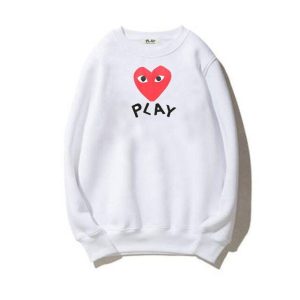
Some fashion logos need an explanation. Others need no introduction at all.
The little red heart with two curious eyes belonging to COMME des GARÇONS PLAY is firmly in the second category. It can appear on a plain T-shirt, a cardigan, a hoodie, or a pair of sneakers, and almost instantly it tells a story about Japanese fashion, contemporary streetwear, and one of the most unconventional fashion houses in the world.
Yet the simplicity of the logo can be misleading.
Behind that small heart is a much larger story—one involving Rei Kawakubo, the experimental philosophy of COMME des GARÇONS, Polish graphic artist Filip Pagowski, the rise of premium casualwear, and the changing relationship between luxury fashion and everyday clothing.
PLAY was introduced in 2002 as a diffusion line of COMME des GARÇONS. Unlike Kawakubo’s highly conceptual main collections, PLAY concentrated on approachable wardrobe staples such as T-shirts, shirts, sweaters, hoodies, and other casual pieces. The line eventually became one of the most recognizable parts of the entire COMME des GARÇONS universe.
What makes PLAY particularly interesting is that it achieved this recognition without abandoning the spirit of its parent company.
It simply expressed that spirit in a quieter language.
Where the Story Begins: The World of COMME des GARÇONS
To understand PLAY, it helps to understand the world that existed before it.
COMME des GARÇONS was founded by Japanese designer Rei Kawakubo in Tokyo in 1969. From its earliest years, the company developed a reputation for questioning conventional ideas about beauty, femininity, proportion, and what fashion was supposed to look like.
Kawakubo did not build her reputation by creating clothes that simply made the wearer look conventionally attractive. Instead, she experimented with unusual silhouettes, asymmetry, exaggerated proportions, unconventional construction, and ideas that challenged the boundaries between clothing and art.
The Metropolitan Museum of Art has described Kawakubo’s work as a continuing challenge to conventional ideas of beauty and fashionability, emphasizing her interest in spaces “in-between” established categories.
That philosophy became one of the defining characteristics of COMME des GARÇONS.
But there was another side to the company.
A fashion house could be intellectually ambitious without making every product difficult to wear.
That distinction became important when PLAY arrived.
2002: A New Chapter for COMME des GARÇONS
In 2002, COMME des GARÇONS introduced PLAY.
The timing was significant. The early 2000s were witnessing a growing interest in casual clothing, graphic T-shirts, sneakers, and fashion that could move easily between the street and more sophisticated environments.
PLAY entered this world with an unusually simple proposition.
Instead of asking customers to understand an elaborate runway concept, it offered familiar garments and placed a distinctive visual identity on them.
T-shirts became one of its strongest foundations. Hoodies, cardigans, polo shirts, and other everyday pieces followed the same philosophy.
The result was almost the opposite of the complicated image many people associated with COMME des GARÇONS.
There were no enormous sculptural shapes.
No deliberately confusing silhouettes.
No requirement to understand an abstract fashion concept before appreciating the garment.
PLAY was approachable.
And that approachability would become one of its greatest strengths.
The line has been described as one of the company’s more accessible arms, helping introduce a wider audience to the COMME des GARÇONS name.
The Heart That Changed Everything
The defining moment in PLAY’s identity came through its heart logo.
The graphic was created by Polish artist Filip Pagowski, whose illustration became inseparable from the identity of the line. The design depicts a stylized heart with two eyes appearing to look outward at the viewer.
It is charming without being childish.
Simple without being boring.
And, most importantly, immediately recognizable.
That is an extraordinary achievement for a logo.
Fashion branding often depends on initials, monograms, repeated patterns, or elaborate symbols. PLAY went in another direction. Its identity was reduced to an image that could be understood almost instantly.
A person could see the heart from across a street and recognize it.
That visual clarity helped PLAY move comfortably between different worlds: fashion boutiques, sneaker culture, university campuses, streetwear communities, and everyday wardrobes.
The heart eventually became one of the most recognizable symbols associated with the broader COMME des GARÇONS empire.
Why the Logo Works So Well
There is something clever about the emotional neutrality of the PLAY heart.
It does not look aggressive.
It does not look excessively luxurious.
It does not communicate wealth in the traditional sense.
Instead, it looks curious.
The eyes give the heart personality, turning a simple geometric symbol into something that feels almost alive.
That personality is important because PLAY’s clothing is otherwise relatively restrained.
Imagine a plain white T-shirt with no graphic at all.
Now place the small heart near the chest.
Suddenly, the shirt has an identity.
The same principle works with a black cardigan, a grey sweatshirt, or a simple pair of sneakers.
The logo does not overwhelm the garment.
It gives the garment a point of recognition.
This balance between simplicity and identity became one of PLAY’s greatest commercial advantages.
The Philosophy of “Everyday” Fashion
One of the most interesting things about PLAY is how ordinary its clothing can appear.
That might sound like criticism.
It is actually part of the concept.
A major COMME des GARÇONS runway collection might challenge the traditional relationship between fabric and body. PLAY, by contrast, can begin with something as familiar as a cotton T-shirt.
The radical idea is not necessarily in the shape.
It is in the context.
A simple T-shirt becomes connected to one of the most influential experimental fashion houses in modern history.
This allowed PLAY to occupy an unusual position.
It was not ordinary mass-market clothing.
But it also was not intimidating runway fashion.
It lived somewhere in the middle.
That middle ground became increasingly important as luxury and streetwear began moving closer together during the 2000s and 2010s.
From Tokyo to a Global Audience
Although COMME des GARÇONS was born in Japan, its influence had long since become international.
PLAY benefited from that global reputation.
Customers did not necessarily need to understand every aspect of Rei Kawakubo’s design philosophy to recognize the significance of the heart.
For some people, PLAY was their first contact with COMME des GARÇONS.
That is an important distinction.
The mainline collections could be challenging and expensive. PLAY provided a more accessible doorway into the wider universe.
A person might first buy a PLAY T-shirt.
Later, they might discover COMME des GARÇONS SHIRT.
Then perhaps a fragrance.
Then Dover Street Market.
Then Kawakubo’s runway collections.
In that sense, PLAY became more than a clothing line.
It became an introduction.
The Rise of the Heart-and-Sneaker Era
One of PLAY’s most important relationships developed with Converse.
The collaboration eventually became one of the most recognizable sneaker partnerships in contemporary fashion.
The classic Converse silhouette already possessed enormous cultural recognition. PLAY added its unmistakable heart motif, creating a product that combined an ordinary American sneaker icon with a distinctly Japanese fashion identity.
The partnership became especially associated with the Chuck Taylor and later other Converse silhouettes. Highsnobiety notes that the first major COMME des GARÇONS PLAY and Converse collaboration appeared in 2015 and quickly became a major success.
The reason the partnership worked was surprisingly simple.
Neither side needed to completely reinvent the other.
Converse brought the familiar shape.
PLAY brought the heart.
The result was recognizable from a distance while still feeling different from a standard pair of Converse sneakers.
That is often the secret of successful collaborations: not destruction, but contrast.
When a Logo Became a Cultural Shortcut
By this point, the PLAY heart had developed a strange kind of cultural power.
It no longer simply identified a product.
It communicated membership.
Wearing the heart could suggest an interest in Japanese fashion, contemporary design, streetwear, sneakers, or luxury casualwear.
And because the logo was so small and uncomplicated, it could fit almost anywhere.
That versatility mattered.
The same heart could appear on a teenager’s hoodie, an adult’s cardigan, or a sneaker worn with formal trousers.
PLAY did not demand a complete wardrobe transformation.
It could be added to one.
The Beauty of the Basic T-Shirt
Few garments demonstrate the philosophy of PLAY better than the humble T-shirt.
The T-shirt is perhaps one of the least complicated pieces of modern clothing.
There is no elaborate tailoring.
No complicated fastening system.
No need for a dramatic silhouette.
It is simply fabric, shape, and function.
PLAY understood that the power of such a garment could come from identity rather than complexity.
The heart became the detail.
This is why PLAY T-shirts have remained central to the label’s image. Highsnobiety describes the line’s everyday basics as a key reason for its broad appeal, with the heart logo providing the visual signature.
The concept is almost architectural in its restraint.
Remove everything unnecessary.
Keep the recognizable symbol.
Let the wearer provide the personality.
PLAY and the New Meaning of Luxury
PLAY also contributed to a larger transformation in fashion.
Luxury was once heavily associated with formal clothing, elaborate craftsmanship, and obvious signs of exclusivity.
But the modern luxury customer increasingly wanted clothing that could be worn casually.
T-shirts, hoodies, sneakers, sweatshirts, and knitwear entered a space once dominated by suits, dresses, and formal accessories.
PLAY was perfectly positioned for this transition.
Its products could be casual without feeling anonymous.
They could be simple without feeling cheap.
They could be recognizable without relying on an enormous logo.
That combination became extremely powerful.
In many ways, PLAY helped demonstrate that luxury fashion did not always need to look luxurious.
Sometimes it could simply look effortless.
The Role of Celebrity and Street Culture
As PLAY became more visible, celebrities and musicians helped push the heart logo further into popular culture.
Figures associated with contemporary music and fashion were photographed wearing the label, helping introduce it to audiences far beyond traditional luxury-fashion circles. Highsnobiety has identified early high-profile wearers including Justin Timberlake, Pharrell Williams, Kanye West, and Rihanna.
Celebrity visibility alone does not create a lasting fashion identity.
But when the product itself is immediately recognizable, celebrity exposure can accelerate recognition.
The heart did not need to be explained.
People remembered it.
That made it particularly effective in photographs, music videos, social media posts, and street-style imagery.
PLAY Is Not the Same as Mainline Comme des Garçons
It is important not to confuse PLAY with the entire COMME des GARÇONS label.
PLAY is a specific diffusion line within a much larger fashion company.
The distinction matters because the two can communicate very different things.
Mainline COMME des GARÇONS is famous for conceptual experimentation and collections that challenge conventional assumptions about fashion.
PLAY is considerably more straightforward.
Its strength is repetition.
A heart on a T-shirt does not need to reinvent itself every season.
In fact, changing it too much could destroy what makes the line successful.
PLAY therefore demonstrates an unusual lesson in fashion:
Innovation does not always mean constant visual change.
Sometimes innovation means knowing which idea is strong enough to repeat.
Collaborations Expand the Heart
PLAY’s collaborations have helped the heart travel into new cultural territory.
The Converse partnership is perhaps the most famous, but PLAY has also participated in collaborative projects involving brands such as Nike and The North Face. A 2020 “PLAY TOGETHER” initiative, for example, brought PLAY together with several major brands.
These partnerships worked because the heart could adapt without losing its identity.
Put it on a sneaker and it becomes streetwear.
Put it on outerwear and it becomes technical fashion.
Put it on a cardigan and it becomes understated luxury.
The symbol remains the same.
Its surroundings change.
That flexibility is one of the reasons the heart has survived for so long.
The Difference Between Cute and Cool
There is also a subtle contradiction at the center of PLAY.
The heart is cute.
But COMME des GARÇONS is not traditionally a “cute” fashion house.
That tension makes PLAY interesting.
The heart softens the intellectual seriousness associated with Kawakubo’s world.
At the same time, the COMME des GARÇONS name gives the heart credibility within fashion.
The two sides balance each other.
The result is neither pure streetwear nor traditional luxury.
It is something in between.
And “in between” is particularly appropriate when discussing Kawakubo, whose work has repeatedly questioned the boundaries between categories. The Met’s 2017 exhibition explicitly examined this idea of occupying spaces between established opposites.
Why PLAY Became So Recognizable
There are thousands of fashion logos.
Very few can be identified from such a small amount of information.
PLAY’s success comes from several things working together:
The heart is simple.
The eyes give it personality.
The placement is often restrained.
The garments are familiar.
The COMME des GARÇONS name provides credibility.
And the logo works across age groups and genders.
This creates a rare combination of recognition and versatility.
You do not need to build an entire outfit around PLAY.
One piece can be enough.
PLAY in the Digital Age
The rise of social media made recognizable visual symbols even more valuable.
On Instagram, TikTok, Pinterest, and street-style platforms, clothing is frequently viewed as a photograph before it is experienced in person.
A distinctive logo can therefore function almost like a visual signature.
The PLAY heart is particularly suited to this environment.
It is small enough to look understated in real life but distinctive enough to be recognized in an image.
That balance has helped the brand remain relevant even as fashion trends have changed dramatically.
The heart has not needed to chase every trend.
It has simply continued appearing.
A Brand Built Around Recognition, Not Noise
Perhaps the most impressive aspect of PLAY is how little it needs to say.
The garments are usually not covered in enormous graphics.
The colors are often straightforward.
The silhouettes are familiar.
The branding can be as small as one heart.
Yet that tiny symbol carries the weight of an internationally recognized fashion house.
There is confidence in that restraint.
It suggests that a brand does not always need to shout to be noticed.
Sometimes the strongest identity is the one people recognize before they consciously realize what they are looking at.
The Lasting Legacy of COMME des GARÇONS PLAY
More than two decades after its launch, PLAY remains one of the most recognizable diffusion lines connected to COMME des GARÇONS.
Its significance goes beyond T-shirts and sneakers.
PLAY helped demonstrate that conceptual fashion could create an approachable everyday language.
It connected Japanese avant-garde fashion with casual global dressing.
It showed how a single graphic could become an international cultural symbol.
And it helped make the idea of the premium basic a central part of contemporary fashion.
Most importantly, PLAY did something that sounds simple but is remarkably difficult:
It made simplicity memorable.
Conclusion: The Little Heart With a Very Big Story
The history of COMME des GARÇONS PLAY is ultimately a story about contrast.
It began inside one of fashion’s most experimental houses but became known for simple clothing.
It carries a luxury name but often looks casual.
Its famous symbol is playful, yet the company behind it has a deeply intellectual approach to design.
Its clothes can be instantly recognizable without being aggressively branded.
And its signature heart is friendly enough for everyday life while remaining connected to Rei Kawakubo’s much larger challenge to conventional fashion.
Since its introduction in 2002, PLAY has grown from a diffusion line into a global fashion language. The Filip Pagowski-designed heart transformed ordinary garments into recognizable objects, while collaborations—particularly with Converse—helped carry that identity into sneaker and streetwear culture.
But perhaps the most lasting achievement of PLAY is not the heart itself.
It is the idea behind it.
Fashion does not always need to be complicated to be meaningful.
Sometimes a plain shirt, a familiar sneaker, and one small symbol are enough.
The heart looks as though it is simply watching the world go by.
In reality, it has become one of the most recognizable little characters in modern fashion.
And that is the cleverness of COMME des GARÇONS PLAY: it turned a tiny heart into a global identity without ever needing to make it complicated.